This book was long overdue. So many years in the making. But the truth is, for most of those years, it existed almost entirely in my head.
I spent years fighting with myself, trying to convince myself to sit down and write, only to feel defeated when I didn’t. I became an expert at putting other tasks ahead of the one thing I supposedly yearned to do. There was always something more urgent, something that needed cleaning, fixing, organizing, or finishing. Anything, really, that didn’t involve opening my laptop and facing that blinking cursor.
I would tell my husband and kids about the book I wanted to write, but they were sworn to secrecy. They weren’t allowed to tell anyone. Not because the story was some top-secret masterpiece, but because the thought of someone casually asking, “So, how’s that book coming along?” terrified me more than actually writing the thing.
To say this book has been in the works for over ten years is an obscene oversimplification. It’s like lying on your résumé, except you’re exaggerating your experience by double digits.
The truth is, I don’t even know exactly when Damian first appeared in my mind. I just know that one day, there he was. A glimpse of someone, a fragment of a story, an image I couldn’t quite explain. And the more I focused on what I was seeing, the more the story revealed itself to me. Characters began to take shape, scenes unfolded, and an entire world slowly formed in my imagination.
I could probably dig through my old files and find a copy of the first unfinished manuscript I ever printed. It was definitely before COVID. Then, during the pandemic, I managed to write close to 40,000 words while participating in NaNoWriMo (National Novel Writing Month). Forty thousand words! You would think that kind of progress would have been enough to keep me going.
But no. I stopped again.
And so continued my very complicated, very on-again, off-again relationship with writing. I would have bursts of inspiration, write for a while, feel wonderful about it, and then disappear from my own fictional world for weeks, sometimes months. The characters patiently waited for me while I found yet another excuse not to return.
Everything began to change in early 2025, when I found my beloved writing group.
Every Friday, a group of writers gathered in a cozy coffee corner in the little town of Kent, Connecticut. There was nothing intimidating or pretentious about it. Just a handful of people who loved putting words on paper. Some wrote blogs, others poetry, and some simply brought their journals to jot down whatever was on their minds.
We weren’t all working toward publishing a novel. We didn’t even write the same kinds of things. But we shared something important: the desire to write.
And somehow, just sitting among like-minded people inspired me.
I still remember that first Friday.
I opened Scrivener, switched to composition mode, and stared at the black screen in front of me. The empty page stared right back.
I froze.
Suddenly, I felt as though every pair of eyes in that coffee shop was on me. Of course, nobody was actually watching. Everyone was busy with their own writing, but in my head, I was convinced they could all see that I had absolutely no idea what I was doing.
Just type something, I told myself.
Anything.
And then, the words came.
Clunky at first. Awkward, hesitant, almost as though they had forgotten how to find their way from my imagination to my fingertips. But little by little, they began to flow. The sentences became clearer, the scenes sharper, and before I knew it, I wasn’t sitting in that coffee shop anymore.
I was inside my story.
I could see the characters more clearly than ever before. I could hear their conversations, picture their surroundings, and follow them through scenes that had lived in my head for years but had never quite made it onto the page.
I wrote for two hours that morning.
And I went home happy.
Did I open my laptop the next day and continue writing with newfound discipline and determination?
Absolutely not.
I didn’t touch it again for almost a week.
But when Friday came around, I returned to that little coffee corner, opened my laptop, and wrote some more.
And then I did it again the following Friday.
And the Friday after that.
Those two hours became something I looked forward to all week. At first, they were the only hours I dedicated to writing, but gradually, something began to shift. I started wanting to write at home, too. I would catch myself thinking about the next scene while doing chores, imagining conversations between characters, or wondering what would happen if I took the story in a different direction.
The more I wrote, the more I understood where the story was going.
I developed a little routine. Before starting a new scene, I would reread the chapter I’d written during my previous session. At first, this was something I dreaded. For years, rereading my own work had been an exercise in cringing, second-guessing, and convincing myself that perhaps writing wasn’t for me after all.
But this time, something unexpected happened.
I actually enjoyed what I was reading.
Not in a look at me, I’m a literary genius kind of way. Far from it. I knew there was plenty of editing ahead, awkward sentences to fix, and entire passages that would eventually need to be rewritten.
But I was excited.
I wanted to know what happened next, even though I was the one writing it. I loved the characters. I cared about their struggles, their secrets, their ridiculous decisions, and the world they inhabited.
For the first time, I wasn’t embarrassed by my own story.
I was proud of it.
And that was when I knew, without a doubt, that I had something worth telling.
Damian Grimmson: The Onset had spent years living in my imagination, waiting for me to find the courage, the discipline, or perhaps simply the right little coffee shop to finally bring it to life.
Looking back, I realize that the hardest part of writing this book wasn’t finding the words. It was allowing myself to believe I could write them.
And perhaps the most surprising thing about this entire journey is that somewhere along the way, writing stopped being something I kept telling people I wanted to do.
It became something I actually did.
I became a writer.
By March 2026, I had finally finished the God-knows-what-number draft of my manuscript. But in my head, this was it. The final draft. The one I could confidently hand over to someone else without immediately wanting to snatch it back and rewrite half of it.
I reached out to my writing group in search of beta readers. Three wonderful people volunteered, but only one actually made it through the manuscript. Then, a friend from my artists’ group offered to read it, and out of my entire family, my teenage daughter was the only one brave enough to tackle the whole thing.
So, after years of writing and rewriting, I had three readers.
Three!
But those three gave me wonderful feedback, and more importantly, they gave me the confidence to take the next step.
I contacted my daughter’s former middle school English teacher and asked her to look over the manuscript. Once everything was polished, tidied up, and as ready as I could possibly make it, I turned my attention to the mysterious world of literary agents.
I began researching agents, putting together query letters, writing synopses, and trying to figure out how traditional publishing actually worked. I sent out approximately fifteen query letters, each one carrying a little piece of my hope that someone out there would fall in love with Damian’s story.
Some submissions received immediate automated responses telling me I could expect to hear back within twelve weeks. Others disappeared into the great literary void, never to be heard from again.
Meanwhile, the more I learned about traditional publishing, the more I realized just how long the process could take. Finding an agent could take months or even years. Then came finding a publisher, negotiating contracts, editing, production, and finally, if everything went according to plan, seeing the book on a shelf.
Years. Potentially more years.
And after all the years it had taken me to bring Damian into this world, I simply couldn’t bear the thought of making him wait any longer.
So one day, I said, “Fudge it! I’m going to self-publish!”
Of course, I knew what that meant. From that moment on, everything would fall on me. The editing, formatting, cover design, publishing decisions, marketing, and a hundred other things I probably didn’t even know existed yet.
But I had my eyes on the light at the end of the tunnel.
And that light was a book.
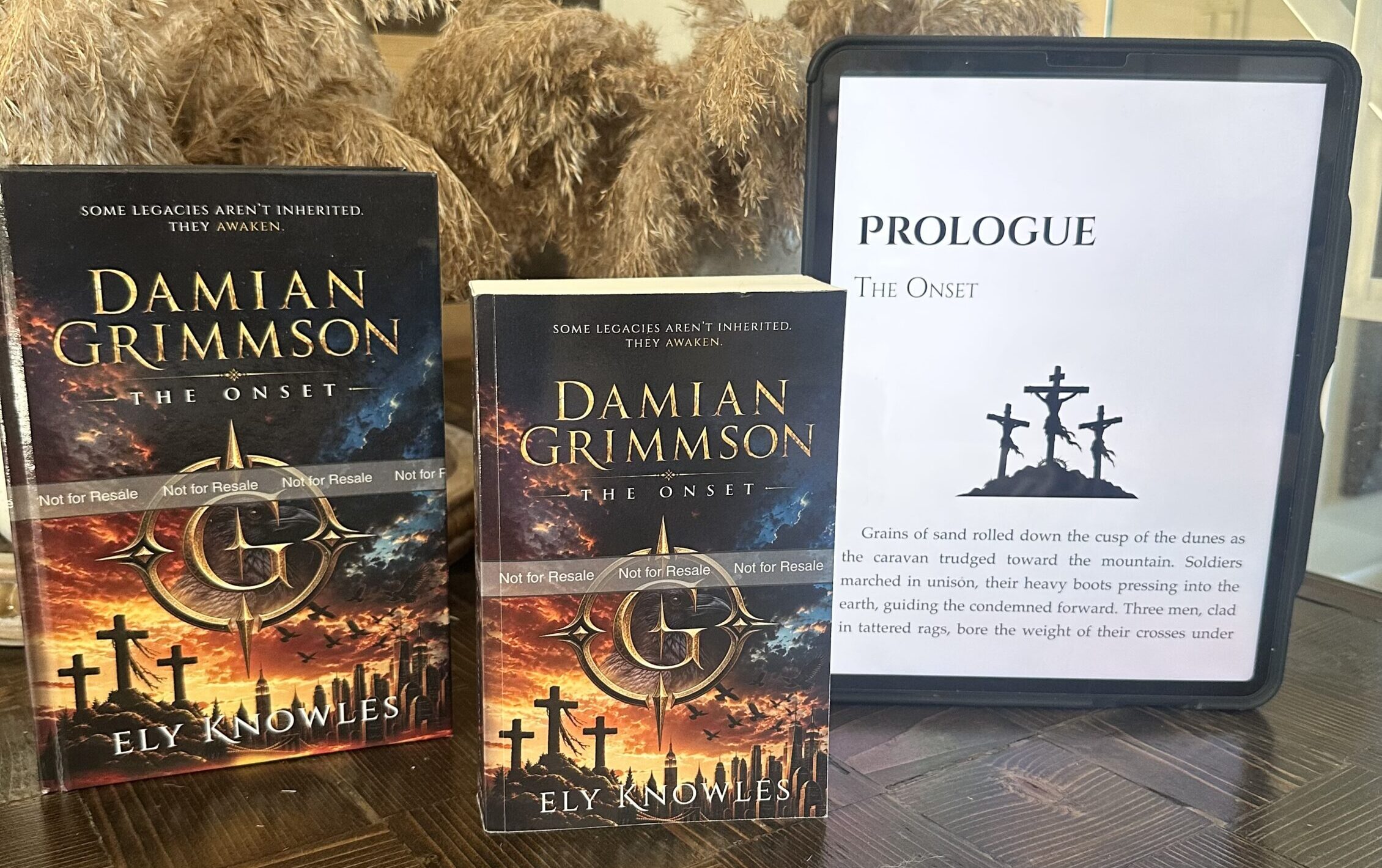
A real, physical book. One I could hold in my hands, place on a shelf, display proudly, and flip through whenever I wanted. After spending so many years with Damian living exclusively in my head and on my computer screen, I wanted to see him in print.
I wanted to hold my baby.
And somewhere along the way, I had come to believe something else: if I genuinely enjoyed reading my own story, surely there would be other people out there who would enjoy it too.
But even if there weren’t, that was okay.
Writing a book had always been something I wanted to do for myself. It was a personal dream, a promise I’d made to myself years ago and had almost convinced myself I would never fulfill.
If other people read it and fall in love with the characters and their world, that would be wonderful.
But that would just be the sprinkles on the cupcake.
The cupcake itself was finally doing what I’d always dreamed of doing.
And now came the next adventure: turning a manuscript into an actual book.
First up, the cover.
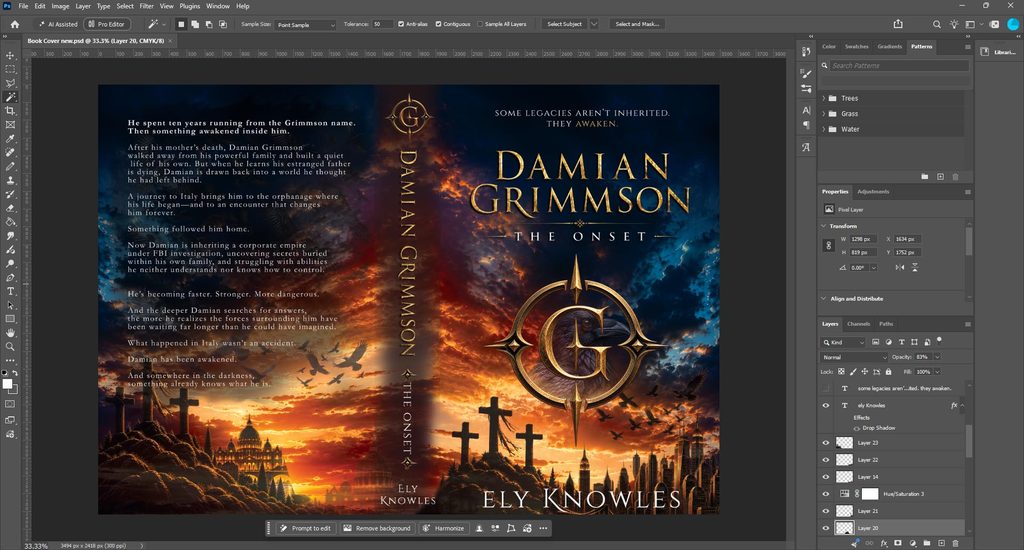
Luckily, graphic design wasn’t entirely foreign territory for me. I’d been dabbling in it for years, building websites, creating digital artwork, and designing marketing materials. So when it came time to create my book cover, I turned to an old, familiar friend: Photoshop.
I knew from the beginning that I wanted complete creative control over the design. I had a very specific vision for the cover, and I wanted to make sure it reflected the mystery and atmosphere of the story without giving too much away.
I also knew I wanted to publish the book in multiple formats and trim sizes, which meant having the flexibility to adjust the design whenever necessary.
And, if we’re being completely honest, there was another very practical reason I decided to do it myself.
Money.
Self-publishing can get expensive very quickly, and I figured that if I already had the skills to do something myself, why pay someone else to do it?
Was I about to make my life significantly more complicated by insisting on doing almost everything myself?
Probably.
But at least I knew exactly who to blame if something went wrong.
And so, armed with Photoshop, a manuscript I’d spent years writing, and a determination that was perhaps bordering on stubbornness, I began the next chapter of Damian’s journey.
This time, I wasn’t just writing a book.
I was learning how to publish one.